Search This Blog

Showing posts with label DEVELOPMENT. Show all posts

Monday, November 26, 2018

Glass birds come to Drysdale


Monday 3rd December 2018 will see the opening of Glass Inspirations – an exhibition of local glass art at Drysdale’s Café Zoo with the theme “Birds of the Bellarine Peninsula”.

The exhibition is the first event in the 2019 Festival of Glass, initiated in 2011 by the Drysdale & Clifton Springs Community Association (now the Drysdale, Clifton Springs Curlewis Association). A sub-committee of the Association runs the annual Festival.

Local glass artists have created a variety of small and large pieces of glass art jewellery and sculptures for Glass Inspirations. Each piece will be unique and hand-crafted on the Peninsula, making them ideal gifts.

Visitors to Glass Inspirations can admire the pieces of glass art, identify the birds and, perhaps, buy one of these unique pieces. If the pressure of having to choose gets too much, Café Zoo can always supply a restorative snack!

Glass Inspirations will run from Monday Dec 3rd to Monday February 11th 2019, between 9.00am and 5.00pm at Café Zoo, 23 High St, Drysdale.

Tuesday, November 13, 2018

Election Q & A in Drysdale


Candidates for the seat of Bellarine in the forthcoming state election faced questions from
around forty north Bellarine voters at a Candidates Forum in Drysdale at 10.00am on 10 November.

The Drysdale, Clifton Springs and Curlewis Community Association (DCSCA) organised and ran the Forum at SpringDale Neighbourhood Centre, 17 - 21 High Street, Drysdale.

Four candidates accepted DCSCA’s invitation to attend: Naomi Adam (Animal Justice Party); Brian McKiterick (Liberal Party); Lisa Neville MP (Labour Party); and Rachel Semmens (Greens).

(Gayle Tierney, member for Western Victoria in Victoria’s upper house, stood in for Lisa Neville who - as Minister for Police - was in Melbourne dealing with a terrorist incident there the previous day.)


From local roads to One Belt, One Road!
Each candidate was given 5 minutes to argue why they should be elected to the seat; each then answered three questions that DCSCA had sent to them beforehand; then audience members were invited to ask their questions.

A wide range of topics was addressed. Some were explicitly about the north Bellarine: a new swimming pool, an offshore sculpture/reef, traffic management and a long-term plan for the area to address what most speakers argued is its over-development.

Other topics were of broader interest: the future of the TAFE system; crime, punishment an prevention; and the Memorandum of Understanding signed recently by the Victoria state government and the Chinese government concerning the latter’s “One Belt, One Road” policy. The event finished at 11.30am.

The Drysdale Forum was the third of four such events being run across the Bellarine Peninsula by the Combined Bellarine Community Associations (CBCA), of which DCSCA is a member.

Thursday, September 22, 2016

A glass and ceramic mural for Drysdale


The "Welcome to Drysdale" mural will be unveiled officially at 1.00pm on Thursday 29th September in Drysdale Town Square.

The mural will be fixed to the outer wall of the Senior Citizens Club, which faces across the town square and is currently blank.

The mural is an initiative of Drysdale’s annual Festival of Glass. Festival convenor Doug Carson said, “The glass and ceramic mural gives glimpses of Drysdale then and now. It’s the latest link in the area’s long association with glass and we’re very grateful to all the local people and organisations that have made the 'Welcome to Drysdale' mural happen."

A local affair
The project started almost three years ago, in December 2013, when Bellarine Secondary College students – led by their teacher Tess Grace and by local ceramicist Kaye Clancy - created a collection of ceramic tiles, each depicting a moment in the area's past and present.

The ceramic tiles form a border to the mural, which has at its centre a sign in ‘slumped glass’ saying "Welcome to Drysdale", made by Geelong’s Wathaurong Glass. Festival of Glass members in Drysdale built the mural’s steel and wood frame.

Festival of Glass committee members Doug Carson and Mercedes Drummond have led the mural project; and Uncle David Tournier of Wauthorong Aboriginal Co-op has been an advisor. The Rotary Club of Drysdale and local travel agency Hello World have supported the project financially.

Thursday, September 1, 2016

DCSCA suggests community communication strategy to Geelong Administrators

Drysdale & Clifton Springs Community Association (DCSCA) has sent a draft Community Communication policy to the Administrators of the City of Greater Geelong (CoGG).

One of the Administrators' tasks is to design a Community Communication Strategy and the DCSCA Committee has sent the Administrators a draft Community Communication Strategy that was adopted in April 2010 by the Affiliation of Bellarine Community Associations (ABCA).

The draft Strategy was produced because for years, community associations on the Bellarine Peninsula – individually and through the collective forum of the ABCA - had levelled detailed criticisms at the City of Greater Geelong over its handling of public consultation. In 2010, the ABCA decided to go beyond criticism and to propose ways to improve the council's communications with its citizens. It submitted a draft consultation policy to the council, intending that it would be the first step in a joint effort to improve the council's consultations.

The council didn't even show the ABCA the courtesy of acknowledging receipt of the document, let alone respond substantively to it. 

The DCSCA Committee has told the CoGG Administrators that the ABCA draft Strategy reflected community attitudes to community communication at the time and that it will assist them to design a contemporary community communication strategy.
 When ABCA submitted its draft Strategy to the council, it accompanied it with a covering letter summarising the draft Strategy; this appears below.

ABCA draft Community Communication Strategy. Covering Letter.
The Affiliation of Bellarine Community Associations believes that the City of Greater Geelong's public communication and consultation practices could be better than they are now; and that improving them would contribute to building a vigorous local democracy. We are keen to contribute to that process and, in that spirit, we make the following two proposals:

1. The City of Greater Geelong should develop a set of protocols concerning its communication and consultation with communities and other stakeholders; and should list specific communication and consultation targets that should be met before any proposal or report is presented to a Council meeting.

2. Each proposal or report presented to a Council meeting should include a section - ‘Communication & Consultation’ - in which the authors show that they have:
(i) communicated with and consulted relevant communities and other stakeholders in accordance with the Council’s communication and consultation protocols
(ii) met the specific targets associated with those protocols.

Such protocols and targets will enable councillors to see whether and to what extent their officers have communicated and consulted with stakeholders in the manner that the Council has decided they should; and they will enable stakeholders to see whether and to what extent their views have been taken into account in a Council proposal or report.

At present, some reports and proposals to Council list and/or summarise the results of consultations, but this practice isn’t consistent. Implementing our two proposals will give continuity and consistency to the Council’s relationships with its stakeholders.

These proposals require no new spending and this alone should commend them to councillors! Indeed, we believe that making the Council’s public communication and consultation consistent with published protocols and targets will streamline officers’ work, instill new stakeholder confidence in the process and provide tangible evidence that the City of Greater Geelong listens to its constituents and wants to promote local democracy. The outcome will be that the Council's public communication and consultation will be easier and quicker (and potentially less expensive) to perform.


Wednesday, August 17, 2016

Who needs SIX liquor outlets?


Dumburra Avenue Cellars in Dumburra Avenue, Drysdale has asked the Victorian Commission for Gambling and Liquor Regulation to grant it a license for a 'packaged liquor outlet'. Granting the license will give the area its sixth liquor outlet.


The Drysdale & Clifton Springs Community Association Inc. (DCSCA) objects to this application because granting the license would have an adverse impact on the amenity of the area and on the objector.

1. Granting the license would have an adverse impact on the amenity of the area
1.1       Granting the license would reduce the overall amenity of the area significantly. The proposal would increase local traffic (on roads unsuitable for it); it would increase the noise of customers and their vehicles; and the proposed floodlit signage would change the area’s character. Further, liquor outlets are often associated with increased levels of rowdy and anti-social behaviour, reducing the area’s amenity still further.
1.2       Granting the license would exacerbate existing problems with traffic safety. The proposal would increase traffic in the area, but Whitcombes Road - the access road to Dumbarra Avenue - is unsuitable for heavy traffic. Its edges are unsealed and muddy, so increased traffic is likely to threaten pedestrian safety and to create more motor vehicle accidents. Further, the intersection of Whitcombes Road and Portarlington Road is dangerous already, so increased traffic in Whitcombes Road will only increase that danger.
1.3       Granting the license would exacerbate existing problems with parking. Cars are frequently – and inappropriately – parked on the vacant blocks beside the shop site. As these blocks are built on, cars will be forced to park elsewhere in the area. Each completed block will have one or two cars associated with it; and there will probably also be two employees' cars per shop – and that takes no account of customers’ vehicles! The result would be that customers to the bottle shop will have no alternative but to park inappropriately and illegally.
1.4       Granting the license would create new problems with rubbish removal. At present, all rubbish from the shops is collected in bins placed on Whitcombes Road. A bottle shop will increase the amount of rubbish significantly, as packaging is discarded – perhaps responsibly, perhaps just thrown to the ground. The increased volume of rubbish will require trucks to remove it, but the application fails to address the issue of rubbish at all.
1.5       Granting the license would create a sixth liquor outlet in the area. The area is well served by liquor outlets already: a bottle shop in each of the two Woolworths stores, a bottle shop in the Aldi Store, another at the Drysdale Hotel and a fifth in Pinaroo Avenue. Significantly, this license is being considered at a time when Woolworths is phasing out the use of cash in its bottle shops, because of the recent prevalence of robberies in its bottle shops. Granting this license would only increase the likelihood of such robberies in the area.

 
2. Granting the license would have an adverse impact on the amenity of the objector.
This objection comes not from an individual objector but from a collective objector - local residents, represented by DCSCA.
2.1       Granting the license would reduce local residents’ quiet enjoyment of their homes significantly. The proposal would increase local traffic (on roads unsuitable for it); it would increase the noise of customers and their vehicles; and the planned floodlit signage would change the area’s character. Further, liquor outlets are often associated with increased levels of rowdy and anti-social behaviour, reducing residents’ quiet enjoyment of their homes still further.
2.2       Granting the license would expose children daily to materials promoting liquor. Several school buses pick-up and drop-off each day in Whitcombe’s Road, directly opposite the proposed bottle shop. So granting the license would expose children every day to materials promoting liquor, which is clearly inappropriate. There is growing concern among experts on addiction as well as the general public about the ubiquitous nature of liquor promotion, which presents liquor as a normal, routine and risk-free part of everyday life; and concerns are also growing about the decreasing age at which children are experimenting with liquor. Granting this particular license would fly in the face of all those concerns.


Wednesday, July 27, 2016

DCSCA comments on town square proposals

-->
DCSCA has lodged a substantial submission with the City of Greater Geelong (CoGG) concerning its proposals to remodel Drysdale's 'town square', including extending the shopping complex.


CoGG’s proposals are in a glossy booklet, copies of which are available at the CoGG Customer Service Centre. The council held an information session at the Senior Citizens' club on the evening of Wednesday 6 July and has invited public comment on the proposals by July 29th.

In its submission, DCSCA congratulated the City of Greater Geelong for the thoroughness of its consultation exercise and the resources it has expended on it. It asked how the council would respond to the submissions, to demonstrate that the consultation was meaningful; and it asked how much the exercise had cost and whether the council had borne the whole cost.

A summary of DCSCA's 4-page submission follows.

Benefits
The proposals offer several benefits. They could refresh the area, enhancing its attractiveness and utility, reinforcing its role as a focal point of the town and boosting connectivity within the town centre. They could also resolve the current mix of gradients, improving access by cyclists and by pedestrians. A small children’s play area should be considered; parents/carers could watch children from the rotunda.

Problems
There are two problems with the proposals: they involve the sale of part of the ‘own square’ to support the extension of the shopping complex; and they add no more parking spaces to accommodate increased custom in the extended shopping complex. (The current car park has less than the regulation number of spaces; extending the complex without adding car parking will worsen an already bad situation.)

Omissions
There are several omissions from the proposals. These include the future of the rotunda, the library and the customer service centre; the traffic implications of the proposed new offices in Hancock Street; the relations with the forthcoming upgrades to Drysdale High Street; and any consideration of how the proposals could provide an ‘energy dividend’, e.g. by increasing energy efficiency in lighting, heating and cooling systems.

Monday, July 25, 2016

Geelong administrators encourage community engagement

-->
DCSCA members heard the three administrators of the Greater Geelong City Council outline their ambitions at a community engagement meeting the administrators ran at Parks Hall, Portarlington on 20 July at 5.30pm.
Geelong City Hall

The administrators are acting as the Greater Geelong City Council, which the Victorian government dismissed on 16 April 2016, appointing Yehudi Blacher as interim administrator. The three administrators are Dr. Kathy Alexander (chairperson), Peter Dorling and Laurinda Gardner. They were appointed on 25 May 2016 and will run the council until elections are held in 2017 for a new council. At this meeting, they were accompanied by six senior council officers.

Administrators’ responsibilities
Dr. Alexander outlined the administrators’ responsibilities as follows:
1. To create a ‘citizens jury’ through which the community can have its say on how the City of Greater Geelong should be governed; to report quarterly to the Minister for Local Government on progress and on issues of concern; and to recommend actions to the Minister.
2. To create a thirty year Vision and Strategy for the municipality.
3. To recommend how the City of Greater Geelong should be governed from 2017. The administrators want to involve all parties and interests in these decisions, so they will seek comment from the community, e.g. through more community engagement forums.
4. To design a Community Communication Strategy.

No more piecemeal development
There followed a question and answer session. Most questions concerned issues at Portarlington, but there was also a call for development in/of Drysdale to be more coordinated and inclusive, rather than the piecemeal approach adopted to date. In response, CoGG’s William Tieppo said that Vic Roads would aim to coordinate the various developments; and subsequently, VicRoads and CoGG have created a Project Control Group to co-ordinate the planning and transport matters that link the Drysdale bypass, the improvements to the High Street and the proposals concerning the future of the ‘town square’.

Thursday, June 9, 2016

Thinking long term about local transport

DCSCA Committee members were among the local people who met Shadow Minister for Public Transport David Hodgett on 10 May at SpringDale Neighbourhood Centre.

Mr. Hodgett was interested in local opinion on a Bellarine Light Rail service; attendees favoured increased bus services, as they would be more flexible.

DCSCA Treasurer Doug Carson has suggested that a light rail service between Geelong and Drysdale would require huge amounts of infrastructure, including stations (with associated parking), rolling stock, drivers, auxiliary staff and perhaps a new tunnel between Kilgour Street and the Geelong Station.

At first sight, then, improving and extending the current bus network would be a simpler, cheaper and quicker way forward. However, before a final decision is taken, there needs to be research to discover:
·      potential routes for:
a) a Bellarine Light Rail system
b) an extended and improved bus network
·      likely patronage of the likely routes in 5, 20 and 50 years time
·      costs of establishing and running:
a) a Bellarine Light Rail system – probably in stages
b) an extended and improved bus network
·      potential funding sources for the construction and maintenance of:
a) a Bellarine Light Rail system
b) an extended and improved bus network.

Population drives policy
Population levels will determine the area’s transport needs, so any decisions about the area’s transport services must be set against the likely population of the Bellarine Peninsula and, indeed, Geelong as a whole in 5, 20 and 50 years time. Therefore, any plan for transport just on the Bellarine needs to be set in the context of a long-term plan for transport in the area as a whole.

DCSCA Committee member Neil McGuinness has suggested that such a long term transport plan should nor just expand the present transport network but also innovate, including such ideas as:
·      extending the Geelong Ring Road to the Bellarine
·      creating road, rail and ferry connections to Avalon Airport (should these be provided publicly, privately or in some combination?)
·      ferry services in Corio Bay and Port Phillip Bay
·      cycle paths - recreational and commuting
·      a road and rail connection between Queenscliff and Point Nepean.

Better transport for commuters or jobs closer to home?
Whatever the content of a long term transport plan for the area, its major aim shouldn’t be to improve commuting. Instead, it should aim to prevent ever-more people commuting out of the area by creating business and jobs for the expanding population of Geelong and the Bellarine Peninsula.

The City of Greater Geelong has actively encouraged the creation of ever more housing estates, home to many thousands of residents, without ensuring that there are jobs to support them. The result is the creation of 'dormitory towns' as an increasing number of people on the Bellarine joining commuters from Geelong on the hours-long commuter trek to and from central Melbourne on roads that were never expected to carry the current levels of traffic.

CoGG's drive to expand the population of the Bellarine must be accompanied by plans to expand and diversify employment. As a rule of thumb, a new job should be created for each house built. That would at least start to match economic growth with population growth; and transport needs would be for easy, fast connections within the Geelong and Bellarine area, as well as between this area and Melbourne.

Earlier articles on this blog have discussed a Bellarine Light Rail service. Search for these dates:
8 October 2011; 13 December 2011; 10 May 2013.

Saturday, June 4, 2016

DCSCA-initiated Lake Lorne track now open!

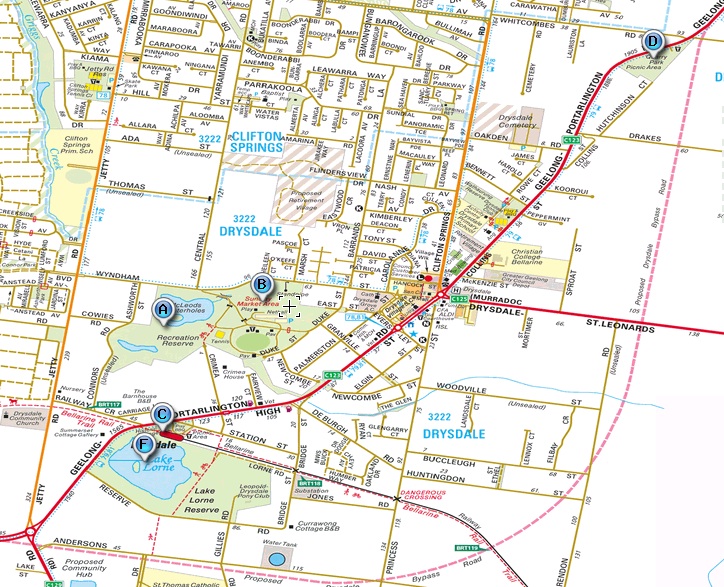
On Sunday 20 May 2016, DCSCA was represented at a small ceremony to officially open a new walking track around Drysdale's Lake Lorne.

It has taken five years to create the track. The then-President of DSCSCA, Roger Lavingdale, presented the idea of the track to the City of Greater Geelong council in 2011; and the council accepted a masterplan for the project in 2012.

Since then, there has been close co-operation and consultation between the council and the various community groups with a stake in the lake's future, including DCSCA, which has been involved closely throughout the project. 

(Picture: L to R Heath Lavingdale, Doug Carson, Merryn Lavingdale, CoGG City Services Manager Will Tieppo and Drysdale Rotary Club President Caroline Rickard.)  

DCSCA Treasurer Doug Carson was one of the speakers at the ceremony; here is what he said:
-->
When I first became involved as a member of the Drysdale Clifton Springs Community Association in 2003, after having moved to the Bellarine in 2000, I was struck by the awareness and passion of a few people, one of them being Roger Lavingdale. He was always looking to put new ideas up for discussion. He was a committee member then, became Vice President in 2005 and 2006 and President in 2007 and 2008 and held those positions very successfully. In the latter part of that time, I was the Association's Secretary and I vividly recall many meetings at his home in Eastwood Court, talking about how to improve the area.


One of these improvements was a walking track around Lake Lorne. Roger became frustrated at the time it seemed to be taking to get the proposal approved, but we just had to wait until all the stakeholders involved agreed on what had to be done. I don’t think anyone really realised just how many stakeholders were involved, and how much planning was needed, e.g. avoiding underground services, dodging trees - the list went on and on. At one stage Roger was heard to mutter, “Give me a bloody bobcat and I’ll put the damn thing in myself!"


However, people at the City of Greater Geelong persisted in working through all the issues and over the past three years we have seen the gradual construction of the Lake Lorne walking track. It will be a lasting legacy to the memory of our mate Roger Lavingdale. On behalf of the Drysdale / Clifton Springs Community Association, I am very pleased to pay my respects to Roger, and thank Drysdale Rotary Club for initiating this day as we commemorate this track and the seat in his honour.  

It works! Locals try out the new track.


Lake Lorne - some background
The area known now as Drysdale - and especially the land around its three waterholes - was a favourite wintering place for Wathaurong people. The name Bellarine derives from the Wathaurong word "Bella Wein" ("a place where you lean on your elbow beside a campfire") and is thought to refer specifically to the waterholes. The inland site provided shelter from cold coastal winds and the lakes provided birds, fishes and plants to eat.

Corroborees were held in the area and archaeologists have found large deposits of shells, animal bones and artefacts in and around the waterholes. Wathaurong traditions and heritage are maintained by Wathaurong people living in the area today.

In the 1830s, in the early days of European colonisation of the area , the term "The Waterholes" referred collectively to what are known now separately as Lake Lorne and McLeod's Waterholes.

In 1872, the Bellarine Shire Council named Lake Lorne after the then Governor of Victoria; and the other two lakes became known as McLeod's Waterholes, probably after Dr. Angus McLeod, principal of the Free Presbyterian Church and School and an active participant in local affairs.

It was also in 1872 that the settlement known as Bellarine or West Bellarine was named Drysdale after Anne Drysdale, a local squatter.

(Sources:
Photos - The Voice; historical background - Lynette Willey [2010] The Waterholes: a history of Drysdale on the Bellarine. Bellarine Historical Society.)

Thursday, April 28, 2016

Bellarine Peninsula misses out on ferry trial

-->
(Source: Herald-Sun)
Businessman Paul Little has announced that on May 16, it will start an eight-week trial of a ferry service between Point Cook and Docklands that won’t include a stop on the Bellarine Peninsula.

In the trial, a catamaran will ferry 400 passengers indoors from Wyndham Harbour near Point Cook, to Docklands' Victoria Harbour in the CBD in the morning peak time; and will return during the evening peak time. Mr Little's Little Group has established a new company - Port Phillip Ferries – to run the service, which will take around 70 minutes each way. The new company wants to reduce the travel time, which it says is due to low speed limits on the Yarra River.

An adult return fare will cost around $20 during the trial, while the normal cost will be $25 for an online booking and $29 if bought on the day, with discounts for seniors, children and concession cardholders. Parking at Wyndham Harbour marina will be included in the fare and ferry passengers will have free wi-fi access.
 
Still no ferry for the Bellarine
When Mr Little first floated his plan for a ferry service in October 2015, it included a stop at Portarlington, but Mr Little said more work was needed to allow ferries to berth there. "We'd be very happy to run the ferries out of Portarlington if the demand was there", he said.

The infrastructure for a Portarlington ferry stop will be completed in the months after the Port Phillip Ferries trial. The 2016 state budget includes money for Stage Two of the $15m ‘safe harbour’ at Portarlington, which includes docking for ferry services and is due to be completed in the 2016-2017 financial year. The budget also includes $107m to build the long-awaited Drysdale bypass which, once complete, will make a Portarlington ferry a more attractive option for people from the western Bellarine who commute to Melbourne.

Begging the question
Point Cook residents who have to spend hours a day travelling to and from jobs in the city would welcome a ferry between Wyndham Harbour and Melbourne’s CBD. Similarly, Bellarine Peninsula residents forced to commute to Melbourne would welcome a ferry between Portarlington and the CBD – either as part of the proposed Port Phillip Ferries service or in addition to it.

However, such ferry services solve a problem that shouldn’t have been created – insufficient business and jobs for the expanding population of Geelong and the Bellarine Peninsula. The City of Greater Geelong has actively encouraged the creation of ever more housing estates, home to many thousands of residents, without ensuring that there are jobs to support them. The result is the creation of 'dormitory towns' as an increasing number of people on the Bellarine joining commuters from Geelong on the hours-long commuter trek to and from central Melbourne.

For example, when the Curlewis ‘growth area’ on the outskirts of Drysdale is completed, it will house  around 16,000 people, yet the area is virtually deserted during the day (apart from builders and tradies building more houses), because so many of its residents are commuters. The only jobs are at the small shopping centre, with its Woolworth supermarket and a handful of ‘speciality’ shops and even these will be at risk as the Leopold shopping centre expands from its present 5,000m2 to 65,000m2 by 2021. (See “More shops, no vision” [13 October 2013] on this blog.)

Creating a jobs drain
An expanded Leopold shopping centre will drain custom from elsewhere on the Bellarine, just as shopping centres in Waurn Ponds and Corio Village have drained custom from central Geelong. The shopping centres provide some new jobs, but most are relatively low-skilled, low-paid and with very limited career paths. Why are there no plans to provide other sorts of jobs?

CoGG's drive to expand the population of the Bellarine must be accompanied by plans to expand and diversify employment. As a rule of thumb, a new job should be created for each house built. That would at least start to match economic growth with population growth.

Wednesday, January 27, 2016

Treasure Hunters set their sights on Drysdale area

Monday 1st February sees the start of a glass art Treasure Hunt - a new feature of the 2016 Festival of Glass.


21 local businesses are participating in the Treasure Hunt and each one has commissioned a piece of glass art and a small, hand-crafted glass ornament - a ‘Tiny Treasure’ – from local glass artists.
(Right:  Surf Junction's glass shell, commissioned from
Jacquie Campbell.) 

From February 1st, each participating business will display its piece of glass art, together with its ‘Tiny Treasure’. A poster in its window will show that a business is part of the Treasure Hunt. Treasure Hunters will search each participating business for its ‘Tiny Treasure’ and receive a stamp on their entry form for each one they spot.
The Treasure Hunt will culminate in a draw for dozens of pieces of glass art at the Festival Expo on 21 February at Christian College, Drysdale.

Festival of Glass convenor Doug Carson said, “Everyone benefits from the Treasure Hunt. It brings customers to local businesses, it promotes local glass artists and it shows local people the beautiful things that artists make with glass. We hope that the Treasure Hunt will build a strong and mutually-beneficial relationship between the Festival, local businesses and local glass artists.”

Wednesday, December 9, 2015

DCSCA helps Vic Roads to prepare for the Drysdale bypass

-->
On 8 December, DCSCA Treasurer Doug Carson discussed progress on the Drysdale Bypass with four independent consultants engaged by Vic Roads.

The consultants were two civil engineers, a lawyer and a project manager; and the aim of the discussion was to ensure that the documentation, analysis, and reporting of the bypass project is thorough and of high quality.

The Drysdale bypass has been an issue locally for several years, but interest grew in the lead-up to the 2014 state election. The state seat of Bellarine was a marginal seat and both major parties promised to fund the bypass if elected. The Labor Party was elected and work on the Drysdale bypass has started.

Local views on local issues
Doug Carson’s comments to the consultants drew on the views expressed in recent public consultations about the bypass. “I told the consultants that Drysdale becomes gridlocked during peak hours and peak holiday times”, he said, “And that trucks, school buses and through traffic would not clog up the town if an alternative route was available.”

Carson also told the consultants that there was concern that without thorough planning and modelling, the bypass could create traffic chaos at the existing Jetty Road roundabout and at nearby Peninsula Drive, where upwards of 5,000 students go to school and where a 35-acre site is set to become a massive Sporting Precinct.
 
Balancing the benefits
The consultants suggested that the current plan for a 6kms bypass with five roundabouts could lengthen journey times on the bypass, making it a less attractive option. “A bypass must balance the benefit of a quicker route with the benefit of easy access”, they said; “A ‘true’ bypass has an entrance and an exit, with no junctions in between.”

In his response, Carson said that the current plan was received well in two local consultation sessions; and that altering the plan by removing roundabouts would have significant effects on local traffic. “If the junction of Grubb Road, Jetty Road and Drysdale High Street was reconfigured to include a flyover for east-west traffic”, said Carson, “that would eliminate one roundabout in the bypass. However, removing any of the proposed roundabouts at Princess Street, Murradoc Road and Whitcombes Road would cause problems for local traffic.”

Different means to the same ends?
Finally, Carson told the consultants that some people have suggested upgrading Andersons Road between Grubb road and the Portarlington-Queenscliff Road as an alternative means to ease traffic in central Drysdale. “The upside is that the road exists already, shortening the construction phase” said Carson. “The downsides are that Portarlington residents would have to drive further to the start of this alternative bypass; and that the drive will be even less attractive by the proposed ferry from Portarlington creating more traffic.”

The consultants will present a report to VicRoads at the end of their consultations.

Thursday, November 19, 2015

DCSCA submits "Top 6" proposals to council's budget program

-->
The Drysdale & Clifton Springs Community Association Inc. (DCSCA) has today lodged its “Top 6” projects with the City of Greater Geelong’s Community Budget Submissions program.
Oh really?

The program invites community groups and organisations to submit proposals for consideration as the council prepares its 2016-17 budget.

Eligible projects would consist of capital works on council assets, but there is plenty of opportunity for local ‘in kind’ contributions by local communities. For example, DCSCA has good links with local clubs, groups and schools; and it would be happy to assist in collecting information for scoping studies and in disseminating their results for public comment.

Below are abbreviated versions of DCSCA’s Top 6 projects. (It was meant to be “Top 5”, but three projects tied for 4th place!)

-->
1. A Swimming Pool at the Drysdale Sports Precinct
The council should create an indoor/outdoor swimming pool and related facilities as part of the Drysdale Sport Precinct, to service the central Bellarine. Council officers have said that the population of Drysdale and Clifton Springs needs be 45,000 to justify a pool; but this figure is based on a recommendation from 2008 – six  years ago – since when the advice and recommendations of health and leisure professionals has changed significantly. For instance, in March 2012, Parks and Leisure Australia (PLA) recommended that a 25m pool should be provided for a population of 30,000 people (http://www.parksleisure.com.au/documents/item/1280).

If a pool in Drysdale were to open tomorrow, it would serve a population of over 35,000 (i.e. well over the PLA recommendation), with summer holiday-makers increasing the figure to approximately 55,000. However, Drysdale is a designated Growth Area, which means that its population will increase to approximately 40,000 by 2019; with summer holiday-makers increasing the figure to approximately 65,000. At the same time, the pressure on Ocean Grove's already overcrowded pool will continue to grow independently, as it, too, is a designated Growth Area; and the imminent closure of the privately owned pool in Portarlington will only make a bad situation even worse.

The project should be in four stages:
1: A scoping study to determine community support; to forecast needs, patronage, benefits and, therefore, design; and to estimate costs.
2: Construct the swimming pool.
3: Construct a Wellness Centre (Hydrotherapy, Gym, Spa, Sauna).
4: Construct waterslides, a diving pool and a competition pool.

-->
Objectives of the project
·      To provide long-term, water-based sporting, health, educational and social benefits to people of the central Bellarine Peninsula, especially the 3,500 students at 3 local kindergartens and 6 local schools.
·      To reduce the costs and the 'carbon footprint' of travel to and from existing pools (e.g. Ocean Grove - over-subscribed already)
·      To increase and diversify local employment and career opportunities.
·      To provide a new attraction to potential tourists.
·      To create economies of scale (infrastructure and staff) by locating it in the Sports Precinct.

-->
2. A lookout tower on Murradoc Hill, Drysdale
The council should design and build a lookout tower on Murradoc Hill, in Drysdale. This is the highest point of the Bellarine Peninsula and it offers panoramic views around the peninsula and over Port Philip Bay to the Mornington Peninsula. A lookout tower at this location would be a ‘must see’ destination – not just for tourists but for Bellarine residents, too. Its attraction would increase traffic in Murradoc Road, offering businesses increasing custom; and the commissioning process could favour local architects and builders, while still seeking value for money.

The project should be in 3 stages:
1: A scoping study to determine community support; to forecast patronage and benefits; to determine site ownership and management; and to set design parameters.
2. Invite proposals (including costs) by competitive tender, actively encouraging local architects and builders to apply, and put them on display for public comment and voting.
3. Commission the construction of the tower and any associated infrastructure.

-->
Objectives of the project:

·      To provide the Bellarine Peninsula with an iconic tourist attraction
·      To increase custom in the  businesses on Murradoc Road
·      To emphasise the tower’s ‘localness’ by actively involving local architects and builders in its design and construction.

3. A Railway Museum at Drysdale Station
The council should collaborate with Bellarine Railway to design and build a Railway Museum at Drysdale Station, as part of Bellarine Railway’s continuing program of renovating and upgrading its sites and rolling stock. The project is likely to attract funds from state and federal governments’ regional funding and from historical and/or rail societies. It is also very likely to attract ‘crowd funding’ (fund-raising online) from rail enthusiasts across the state.

The Museum should be run by a Trust; the council would have no responsibility for its maintenance.

The project should be in 3 stages:
1: A scoping study to determine community support; to forecast patronage and benefits; to determine site ownership and management; to investigate possible sources of Museum contents; and to set design parameters.
2. Invite proposals (including costs) by competitive tender, actively encouraging local architects and builders to apply, and put them on display for public comment and voting.
3. Commission the construction of the Museum.

-->
Objectives of the project:

·      To enhance the attractiveness and social/historical standing of the Bellarine Railway
·      To add to the Bellarine Historical Society’s status as a portal to the region’s history
·      To offer visitors to the area an added incentive to travel on the Bellarine Railway and/or to walk or cycle on the Bellarine Rail Trail.

-->
4. An artificial reef for the Clifton Springs fishing jetty
The council should design and build an artificial reef for the Clifton Springs fishing jetty, as part of its continuing program of improving the stability, access and attractiveness of the Clifton Springs foreshore. The reef will increase fish numbers by offering a relatively safe environment, making the area more attractive to recreational fishers. If practicable, the reef should be made partly or wholly of glass, contributing to the area’s growing reputation as a centre of glass-related activity.

The project is likely to attract funds from state and federal governments’ regional funding. It is also likely to attract ‘crowd funding’ (fund-raising online) from fishing enthusiasts in the region.

The project should have 3 stages:
1: A scoping study to determine community support; to forecast the effects on the usage of the fishing jetty; to determine management of the reef; and to set design parameters.
2. Invite proposals (including costs) by competitive tender and put them on display for public comment and voting. Actively encourage local businesses and glass artists to apply, while still seeking value for money.
3. Commission the construction of the reef.

-->
Objectives of the project:

·      To ensure that fishing at the jetty is sustainable by increasing fish numbers
·      To promote the work of relevant local businesses and glass artists.

4. An artificial reef for The Dell, Clifton Springs
The council should design and build an artificial reef for The Dell at Clifton Springs, as part of its continuing program of improving the stability, access and attractiveness of the Clifton Springs foreshore. The reef will increase the area’s attraction – especially to snorkellers - because it will increase fish numbers by offering a relatively safe environment. Also, it will offer a picturesque view from The Dell lookout. If practicable, the reef should be made partly or wholly of glass, contributing to the area’s growing reputation as a centre of glass-related activity.

The project is likely to attract funds from state and federal governments’ regional funding. It is also likely to attract ‘crowd funding’ (fund-raising online) from snorkelling enthusiasts in the region.

The project should be in 3 stages:
1: A scoping study to determine community support; to forecast the effects on patronage of The Dell; to determine management of the reef; and to set design parameters.

2. Invite proposals (including costs) by competitive tender and put them on display for public comment and voting. Actively encourage local businesses and glass artists to apply, while still seeking value for money.
3. Commission the construction of the reef.

-->
Objectives of the project:

·      To enhance The Dell’s attractiveness a) by increasing fish numbers to encourage snorkelling and b) by offering a picturesque view from The Dell lookout
·      To promote the work of relevant local businesses and glass artists.

 4. Improved access to the Clifton Springs foreshore at Beacon Point
The council should create a new easy and safe access to the foreshore at Beacon Point, as part of its continuing program of improving safety and access at the Clifton Springs foreshore. Easy access and signage should encourage residents and visitors to walk east and west along the Clifton Springs foreshore – perhaps even to take the 2-hour scenic foreshore walk to Portarlington.

The project should have 3 stages:
1: A scoping study to determine community support; to forecast the effects on the foreshore and its infrastructure; and to set design parameters.
2. Invite proposals (including costs) by competitive tender and put them on display for public comment and voting. Actively encourage local businesses to apply, while still seeking value for money.
3. Commission the construction of the new access point.

Objectives of the project:
·      To encourage greater use of the Clifton Springs foreshore for health & recreation.
·      To promote the work of local businesses involved in the project.


Signage for Scenic Trails in Drysdale and Clifton Springs (also submitted)
The council should provide signage at strategic points to identify existing scenic trails for walkers and cyclists. The trails link points of interest and scenic locations around Drysdale and Clifton Springs, such as The Dell Lookout, Lake Lorne, McLeod’s Waterholes and Griggs Creek.

Identifying and promoting these scenic trails will attract more visitors to Geelong and the Bellarine, which DCSCA believes could become an internationally-recognized destination for recreational walkers and cyclists. DCSCA has actively promoted scenic trails in Drysdale, Clifton Springs and the Bellarine Peninsula more broadly. As a result, some are identified in the REMA Tourist Information Map and in the 2014 North Bellarine Business and Services Directory.

The project could start with four signs: at Drysdale Station, the Boat Harbour, The Dell lookout and a location on the Rail Trail.

The project is likely to attract sponsorship, because State and Federal Governments, businesses and service groups would be glad to be associated with it.

Objectives of the project
·      To promote the central Bellarine to potential tourists, especially recreational walkers and cyclists.
·      To reduce health costs by improving community health and well-being through active recreation and social activity.